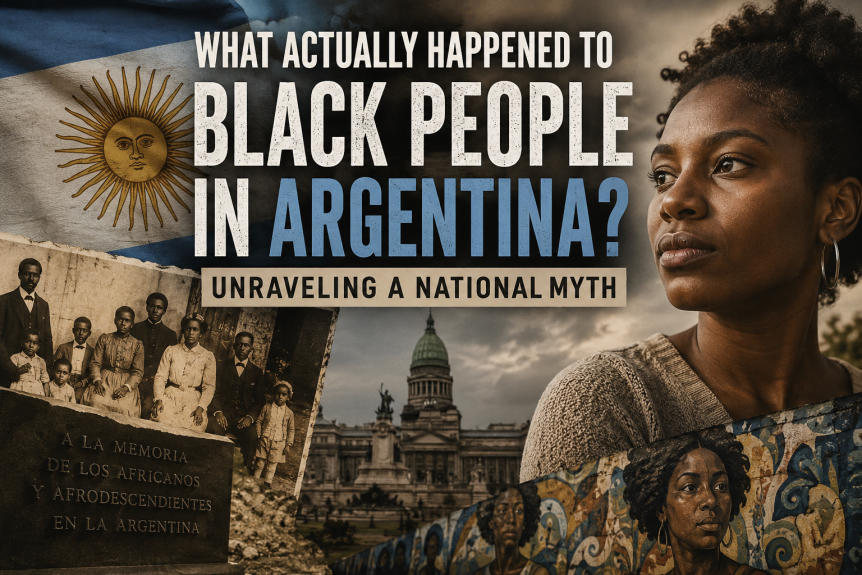
“In Argentina, there are no black people.”
If you ask the average Argentine, or even visit the country’s official tourism websites, you might hear this phrase. It’s a statement that reflects a deeply ingrained national myth: that Argentina is a purely European nation, a country of immigrants from Italy and Spain. Yet, this story doesn’t match the historical record.
In the early 19th century, an estimated 30% of Buenos Aires’ population was of African descent, and in some agricultural regions, the figure was over 50% . Today, the 2022 census shows that only about 0.66% of the population identifies as having Sub-Saharan African ancestry .
So, what happened? This dramatic decline, often discussed in the context of “genocide,” is one of the most controversial and misunderstood chapters in Latin American history.
A History of Erasure
The story of Afro-Argentines begins with the transatlantic slave trade. Africans were brought to the Rio de la Plata region starting in the late 16th century, primarily as domestic workers and laborers . By the time of the Argentine War of Independence (1810-1818), Black people were a significant and visible part of society. They fought in the revolutionary armies, often promised freedom in exchange for their service .
However, this presence was systematically erased from the national narrative. As Argentina built its modern state, elites like President Domingo Sarmiento promoted a policy of blanqueamiento(whitening). The goal was to build a “civilized” nation modeled on Europe, and Black and Indigenous people were seen as obstacles to progress .
The Myth of “Death in the Wars”
One of the most persistent myths to explain the “disappearance” of Black people is that they died en masse in the wars of the 19th century, particularly the War of the Triple Alliance (1864-1870). While many Afro-Argentines were conscripted, modern historians have debunked this as the primary cause .
Researcher Gabriel Morales of CONICET explains that the idea “has no historical proof.” While service in the army caused a “demographic dislocation” as soldiers deserted or moved away, it did not decimate the population .
So, What Really Happened? The Role of Whitening
The sharp decline of the Black population wasn’t caused by a single, cataclysmic event like a classic genocide, but by a confluence of state policies, social pressures, and demographic shifts over generations. It was, in effect, a demographic engineering project. The 1853 Constitution actively encouraged European immigration . This was a deliberate strategy to “dilute” the non-white population through mass migration .
Simultaneously, the state actively promoted racial mixing. Unlike other parts of the Americas that enforced strict segregation, Argentine elites encouraged intermarriage with European immigrants as a way to “improve the race” . The civil code of 1871 removed legal barriers to interracial marriage .
For many Afro-Argentines, this was a survival strategy. Conscious of the stigma of blackness, they sought to “desmarcarse” (disassociate) from their African past . Marrying a white or lighter-skinned partner offered social mobility and a way for their children to escape discrimination . As one historian put it, “not being Black” became an act of maneuvering in a white-dominated society .
This process is not simply about biology. Intermarriage meant that Black cultural practices and community structures were not passed down to the same degree. While many Argentines today have African ancestry, the cultural identity was largely lost as they assimilated into the dominant white society.
Was It Genocide?
This is where the term “genocide” becomes contentious. The United Nations defines genocide as acts “committed with intent to destroy, in whole or in part, a national, ethnical, racial or religious group.”
By this strict legal definition, Argentina’s case is not a “genocide.” The decline was not primarily the result of mass murder but of racial mixing. In fact, the state promoted mixing, not extermination. Recent scholarship supports this view, noting that theories of genocide have been ruled out in favor of the “whitening” through miscegenation theory .
However, this nuanced view must be weighed against the lived experiences of Black Argentines. They describe themselves as “the first disappeared” of Argentina . They point to the same policies of invisibility and forced assimilation as a form of cultural genocide that was socially and politically devastating.
This context reveals a painful reality: Black people didn’t “disappear” from Argentina; they were actively erased from public consciousness and official statistics. The 1895 national census, for example, simply did not count them . It was not until the 2010 census that a question on Afro-descendant identity was re-introduced, nearly 120 years later .
This erasure is a powerful form of racism. It denies a significant part of the population a claim to citizenship in their own country and contributes to ongoing discrimination. As Black activists argue, the invisibility of their history is, in itself, a form of violence .
The Legacy
Today, an estimated 300,000 to over 1 million Argentines identify as Afro-descendant . They are fighting to reclaim their history and their place in the nation. They point out that the national symbol, Tango, is rooted in Afro-Argentine rhythms like candombe . They also point to the first Argentine president, Bernardino Rivadavia, who was of African descent .
The story of Black people in Argentina is not a simple tale of murder, but it is a clear and tragic case of institutionalized erasure. It was a project of social engineering designed to build a white nation, and it succeeded in obscuring the contributions of millions of Afro-Argentines from the nation’s memory.